


There's something I've been noticing for a couple of years now.
Very experienced designers and design leaders keep approaching me with a version of the same problem. They're being asked to lead their teams through an AI transition (set the direction, model the behavior, and have a plan) all while being just as new to this as everyone else. Differently from their teams though, they haven't had the luxury of time and space to figure out AI for themselves.
Not long ago, I had a conversation with a Head of Design at a company you've heard of. She told me she'd been nodding along in leadership meetings about AI strategy for months. She had no idea if what she was agreeing to was right. Privately, her peers told her the same. Publicly, they all went about their business cosplaying as the confident leaders they wanted to be.
She asked if I had any resources to share. Something built for the work she and other design leaders actually do. The closest things I found were prompt guides and workflow tips. Some are useful maybe, but not for someone trying to figure out how to lead a team through something they haven't figured out themselves yet. Not for someone who needs more depth and nuance to make good decisions.
Prompts and LinkedIn advice is not what design leaders need. They need time and space to get into it themselves, hands-on, with peers in the same situation. That's the thing that hasn't existed.
So I built it.
I ran the first session of Claude Cowork for Design Leaders on Tuesday with no idea how it would go.
I assumed the attendees would mostly be Senior ICs. Instead, fifteen Directors, Senior Directors, and Heads of Design showed up. People with real teams, real pressure, and real accountability for figuring this out.
Before the session, I asked everyone to write down the AI agent they wanted to build. Something specific to their work. A repeatable task, a judgment-heavy process, or just something they'd been meaning to get off their plate.
When I opened the session I didn't start with Claude. I asked everyone to open a text editor and answer one question without using AI.
"If this agent does what you want it to, what does good look like versus bad? Write down the observable signals or measurable heuristics you will use to tell the difference."
And y'all, they struggled.
I expected it to be hard. Those kinds of questions are always hard. But watching a room full of senior design leaders who talk about strategy, vision, and quality every single day struggle, that's the reality most are facing. Not because they don't know the answers. They do. But knowing something is very different from writing it down in way someone else can act on. Almost none of us have the time or space to do the second part.
When it comes to AI, that's the gap I see more. Not a gap in what AI is or how it can be used for things like coding or designing, but a gap in articulation. These models work well when given clear rules and decision-logic. They can follow them quite well. But if we can't articulate what we mean, they're going to keep giving answers that are never quite right. They more they do so, the more frustrated and anxious we behome.
At the beginning of the workshop, one of the attendees told me she'd been using Claude every day for the past year. She had a tab open with it constantly. When it came to practical questions that have fact-based answers, it was really helpful. But, every time she asked it for something strategic, something with real stakes, it came back with something that sounded right, yet felt wrong. She'd started to wonder if she was the problem.
She wasn't. She was just missing getting stuck in, and finding a new way out.
Another one of the attendees had been trying to build the same skill for weeks before the workshop. He was already using Cowork and had the same general idea that I presented, but he could never quite get the agent working. By the afternoon, he had a version that was actually doing what he wanted. The only thing that changed was he started treating attempts as tests instead of a finished thing. He stopped trying to get it right and started trying to find out what was wrong over and over again.
The answer is the approach. A few practices borrowed from software engineering, separating building from testing, keeping logs, treating your first version as a draft, and suddenly the whole "working with AI thing" works differently. Not because Claude suddenly got better, but because the articulation and approach got clearer.
When you stop treating AI like a search engine and start treating it like a junior collaborator you're responsible for directing, something shifts. You start noticing where your own thinking is fuzzy. You realize the output you've been frustrated with was never Claude's fault. It was just the mirror doing its job.
That's the shift.
We spent the morning getting criteria out of our heads and onto the page. The afternoon was building, testing, and refining actual agents, doing actual work, getting better in real time.
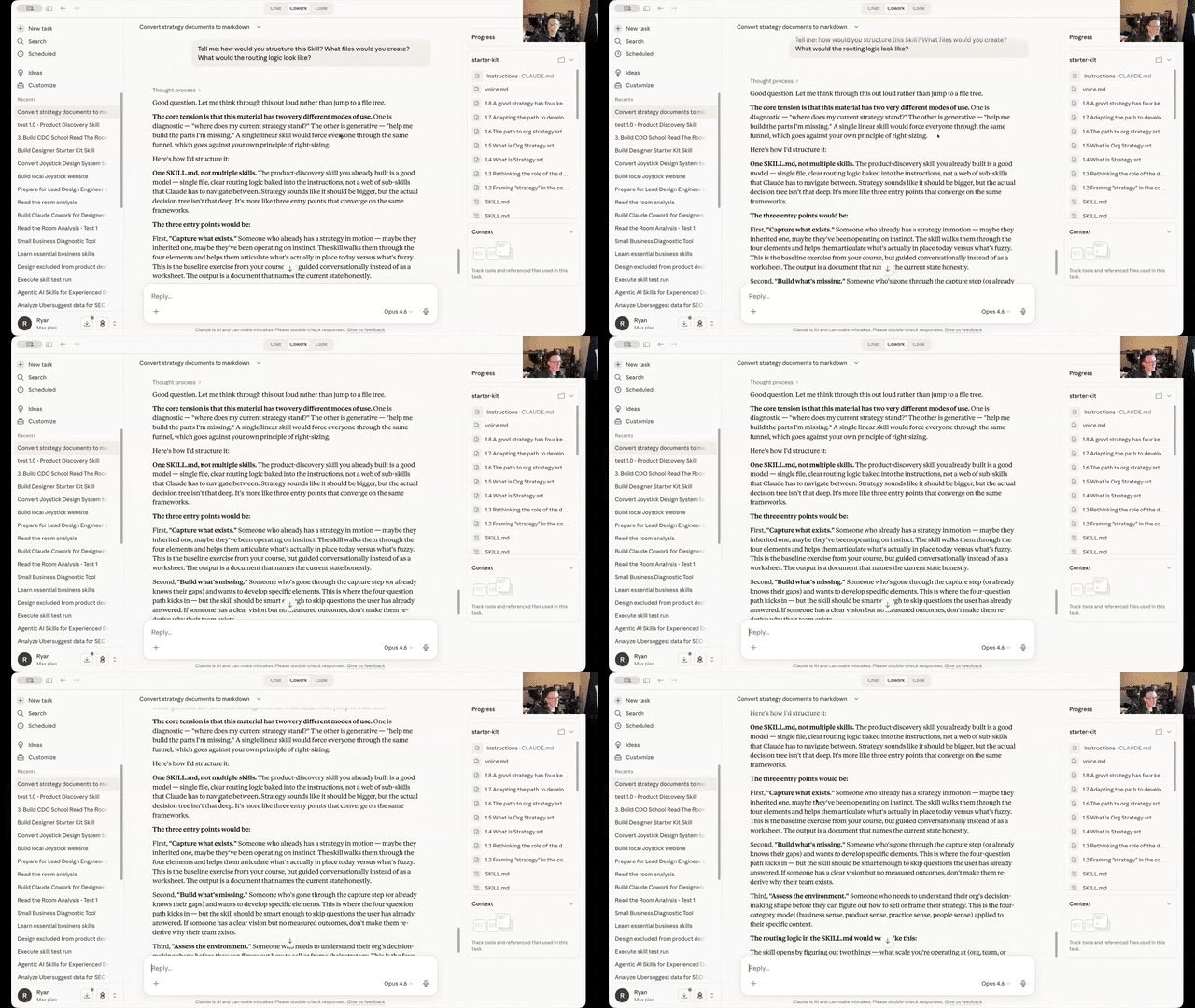
By end of day a Head of UX automated one part of the quarterly planning process and was running live scenarios against her skill. A Senior Director realized she'd been asking Claude to create a Product Vision but had never actually seen a good one in real life. Rather than create an agent for that, she made one to help her create her own heuristics for what makes a product vision good. A University Dean discovered that while her department had a great ratings scale for professors, there was no definition of quality that went with the rating. The agent quickly discovered that there was no clear way to differentiate a 3/5 from a 4/5. As a teacher, she laughed at the irony of that insight.
When I reflect on the day, everyone came in hoping to build something useful. I think they left with something more valuable.
The next morning I got an email from one of the attendees. She'd signed up, gone through the whole day, and some point thought about the relief she was feeling. Not because she had a working the Claude Skill, but because all the anxiety she'd been carrying around the last couple years was gone.
If you're looking for similar relief:
- I'm running the workshop again on Tuesday, April 21st
- Early-bird tickets (20% off) are on sale through Friday, March 27th


